Dare Revavhumbamiri
Terrence Musekiwa
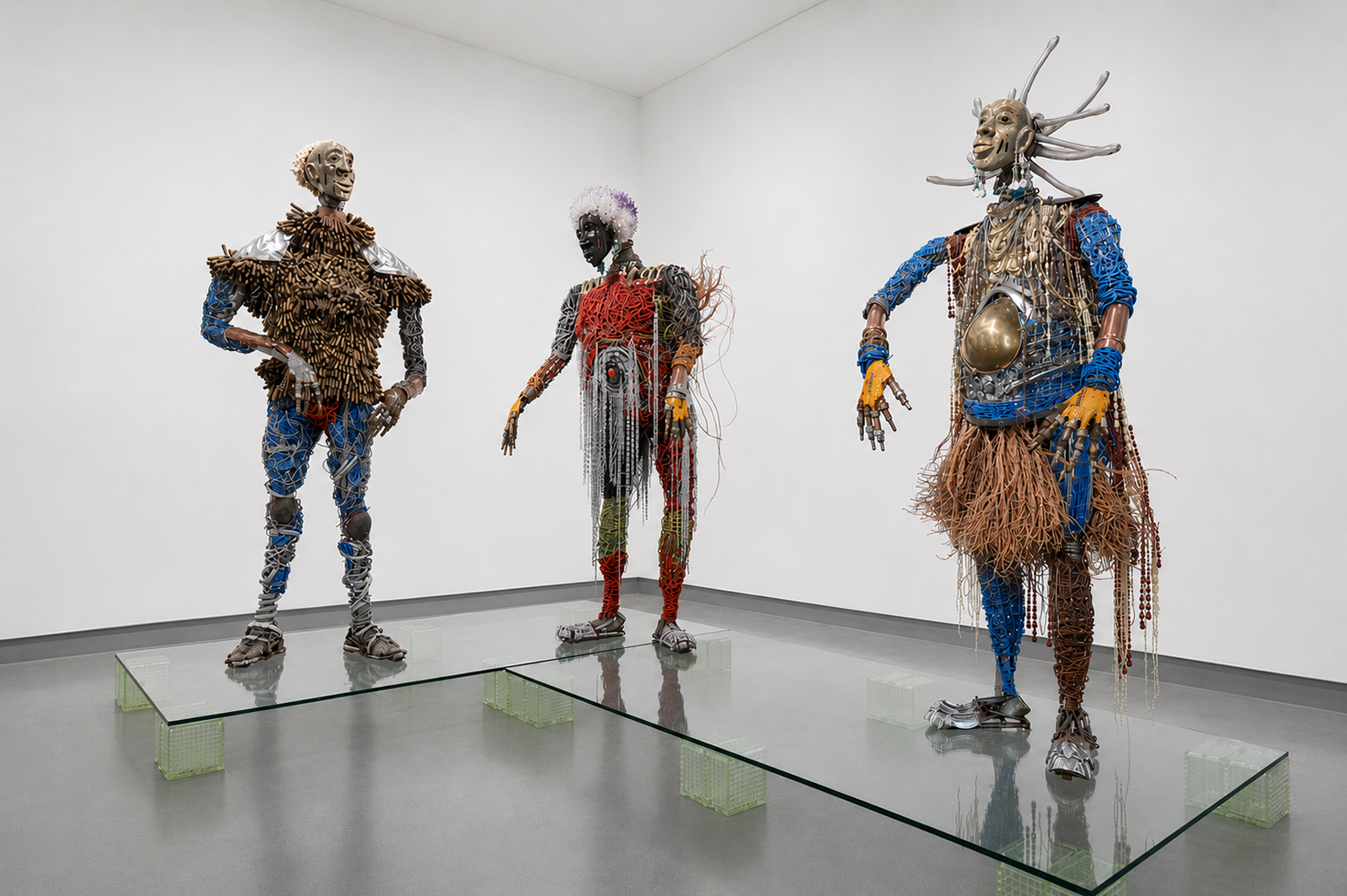
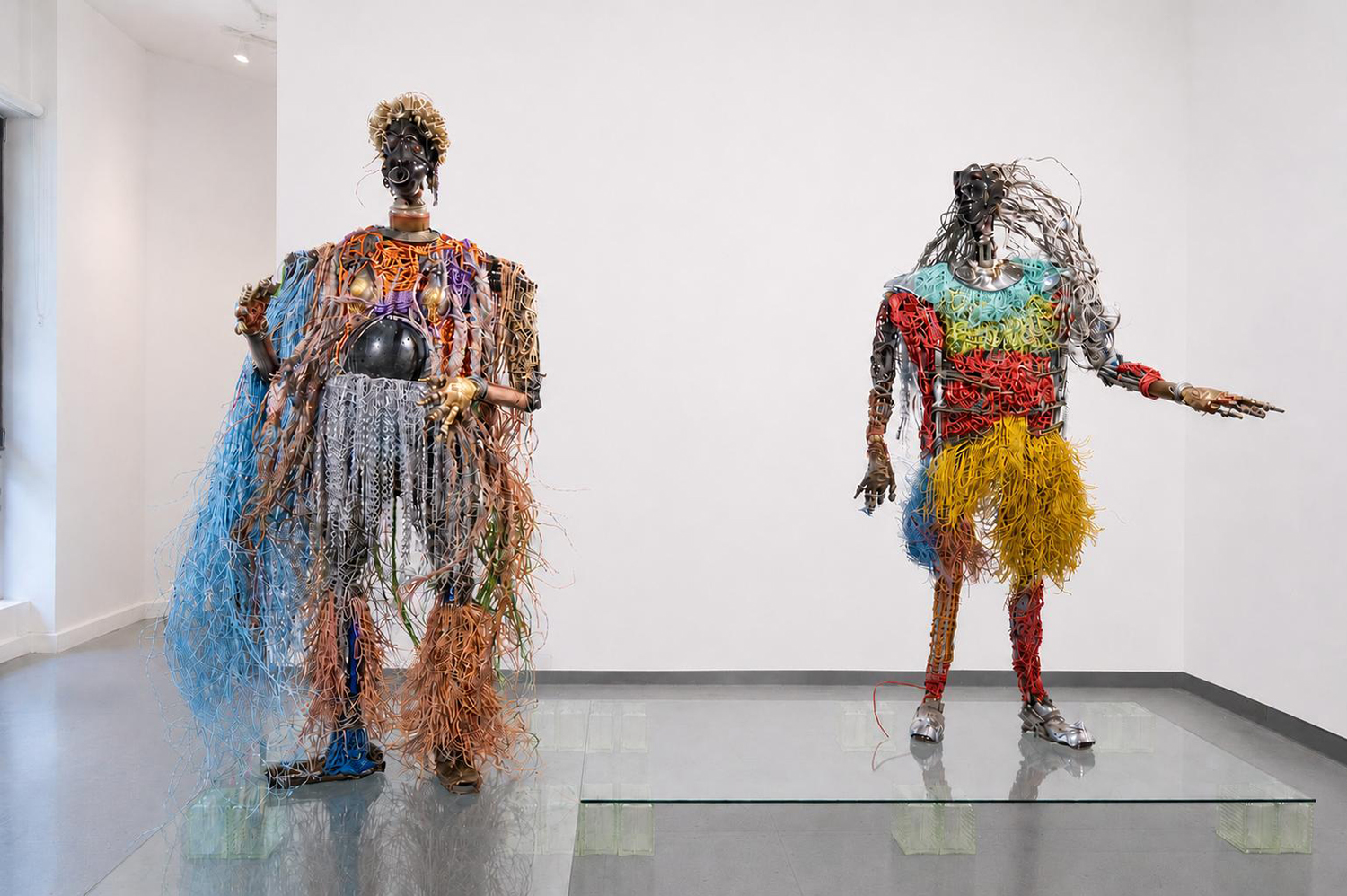
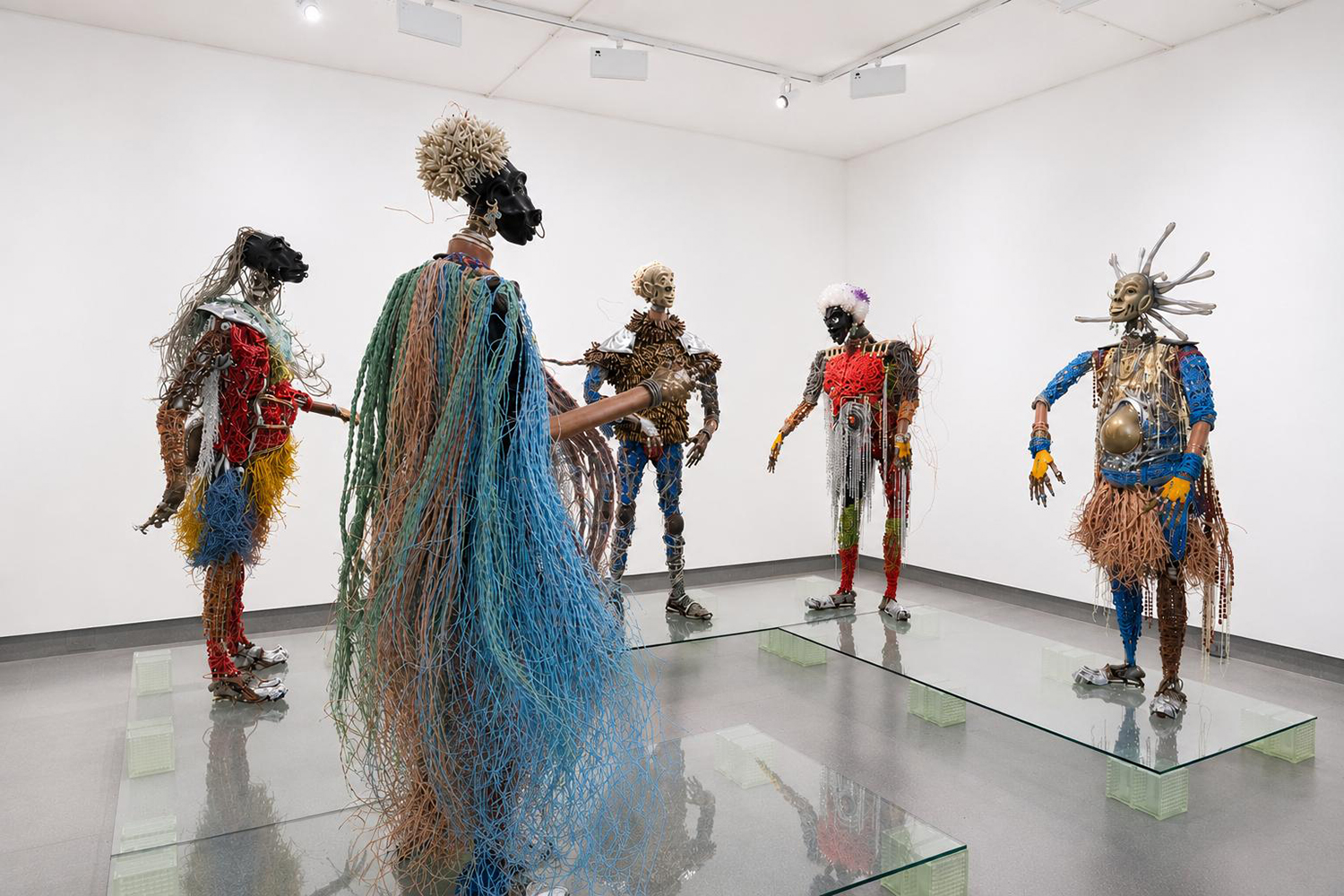
Tabula Rasa is pleased to present Dare Revavhumbamiri, Zimbabwean artist Terrence Musekiwa’s first London solo, developed in collaboration with Catinca Tabacaru Gallery.
Musekiwa comes from a long line of sculptors. He began carving stone at age five alongside his father Kennedy Musekiwa. This grew into him developing a visual language that breaks the divide between traditional and contemporary sculpting. Each work begins with the familiar toil of shaping stone before being fused with found industrial, martial, and domestic objects; a tension that simultaneously challenges and pays homage to Zimbabwean heritage. His conceptual vernacular opens a dialogue about present-day Zimbabwe: its mechanics, politics, micro and macro trade systems, its hardships and the quality of magic that permeates the personal lives of its inhabitants.
Dare Revavhumbamiri is a meeting of five monumental new works. Built from the inside out; bones of cut and fused shopping carts, copper plumbing tubes, skin woven from internet cables, and aluminum fencing, hair and dress meticulously beaded from cowrie shells and deadstock jewelry. These larger-than-life sculptures are pulled from imagination into the physical realm through brute force and painstaking labour. All five are anchored by their carved stone heads drawn from the bowels of Zimbabwe, the head the seat of intention where the ancestor resides. These stones root the work in the geology of southern Africa; each face made in collaboration, in a sense, with the spirit waiting to be revealed.
Dare Revavhumbamiri resists easy translation. Its closest equivalent is something felt rather than defined, the instinctive, enveloping care of a mother bird protecting her young in her thick feathers: a love that cannot be captured in language but is deeply understood. This is how the ancestors are believed to care for the living, and these works are an ode to that. They represent Musekiwa’s lineage of protection, his late father, grandmother, great-great-grandmother and beyond, a council gathered to witness, remember, and transmit.
The works form a shield each with a distinct charge: The Threshold Keeper: copper plates on the torso act as mirrors for the visitor’s face: an invitation to self-audit at the gate. The Law of Kin: bullet and cowrie shells cascade like a genealogy you can touch. The Listener: perforated aluminium panels act as ears to the village and the cosmos. Internet fibres thread the skull, suggesting dreams as networks. The Healer: copper scars soldered visibly, not hidden: repaired as pedagogy. The Witness of Time: a spine of braided cables ascending into a haloed crown, clockwork fragments embedded at the sternum. Not time that passes, but time that gathers.
Connected to Bantu cultural spheres, the works draw on ancestral cosmologies where energy is relational: land to lineage, children to elders, the living to living-dead. Taboos, those formative instructions absorbed in childhood, become architecture, frames that hold a community upright. Songs, warnings, praise-names, the texture of markets and homes are all braised into the surface of each piece: this unconscious inheritance that has shaped Musekiwa’s hand as he builds. Yet the found and salvaged materials insist on the present, literal markers of the globalised world we move through, its histories immediate and still accumulating. The sculptures hold both without resolving the tension between them. There are no longer absolutes or pure traditions; things are forever changing and evolving. Perhaps this is how it has always been, and the illusion was that anything was ever “set in stone”. The result is an embodied archive, a mnemonic you can walk around; carrying the deep past and the recent world in the same breath.