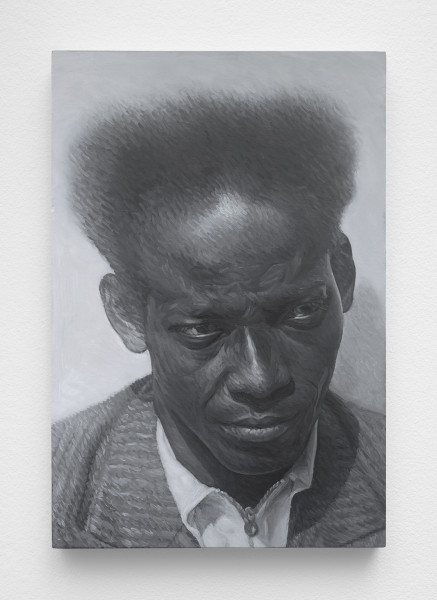
Xavier Robles de Medina
Anton de Kom photographed by Piet Zwart, 1933, Stedelijk Museum Amsterdam, object nr. 1987.1.1599, 2025
Just before the beginning of WWII, across the Atlantic Ocean in colonized Suriname, Anton de Kom began his work in the anti-Dutch movement by bringing together groups that opposed European imperialism and fascism. He pursued the notion of an independent Suriname, which soon resulted in his capture and exile to the Netherlands. Continuing his engagement in leftist politics and later joining the Dutch resistance after the German invasion of 1940, he was arrested in 1944 and imprisoned in Camp Vught, a concentration camp where he died one year later. Examining the human toll of resistance, artist Robles de Medina enters this narrative with an oil-on-panel portrait of Anton de Kom, based on a 1933 photograph by Piet Zwart currently in the Stedelijk Museum collection. Here, the act of replication imbues the work with the emotional weight of its subject: the painting seems to look back at the viewer, taking on a dominant role by confronting the observer and asserting a presence that implies agency.
Anton de Kom wrote We Slaves of Suriname in the interwar years a work that is at once a historical account, an indictment, and a call to his Black compatriots to truly liberate themselves, to free themselves from the control of the white oppressor, and to condemn the Dutch colonial regime. It integrates the experiences of Suriname’s oppressed, multiethnic population into the broader history of South America and contributes to the wider narrative of struggles against slavery, imperialism, and racism.